Data Room Structure Guide
How to organize your data room for investor due diligence.
At its core, a Data Room is a business tool.
It’s a secure, organised digital space where key company documentation is stored in preparation for investment, acquisition, and even major partnerships.
While you may not need one immediately, understanding data room basics early can save significant time later.
What you’ll find in this guide:
Why structure matters
Quick Start
Building your data room index
Organising your data room
Sample data room structure
Why data room structure matters
A strong data room helps investors answer a few key questions quickly:
What does the company do?
How does it make money?
What evidence supports the opportunity?
How is the business structured legally and financially?
When materials are scattered, inconsistently named, or missing context, investors have to assemble the story themselves. That can slow diligence and create unnecessary friction.

Quick Start
Create your core folders.
Build your index.
Add the documents you already have.
Leave placeholders for docs you'll add later.
Update your data room regularly.
Building Your Index
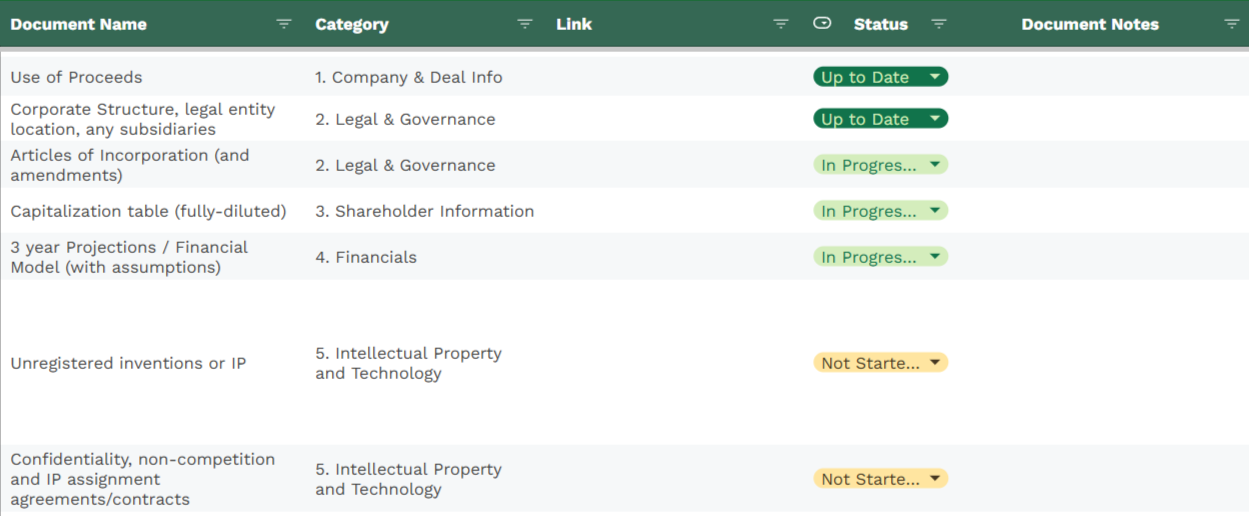
The Data Room Index is your company’s Source of Truth when it comes to documentation. This is the place that your investors and your team will come to when they want to quickly understand what you currently have and where to find it, as well as what’s still in progress.
The Data Room Index is also one of the most underrated tools for showcasing your professionalism and investment readiness.
When build with intention, not only can you demonstrate that you understand what is expected, but you can also head off navigation and status questions, while showcasing transparency and forward-thinking.
At a minimum, an index should:
Link to key documents
Show document status
Highlight items in progress
Note documents that are not applicable
Organising Your Data Room
A well organised data room ensures that investors can find what they’re looking for quickly.
Focus on: Consistent naming conventions, logical folder structure, easy navigation, and current/updated documentation or context for what is missing/outdated.
clean folder structure
Investors should be able to scan your folders and immediately understand where information lives.
The exact folders matter less than consistency and clarity. Consider sharing your folder structure with a trusted advisor or “friendly investor” to assess if there are any immediate red flags for navigability.
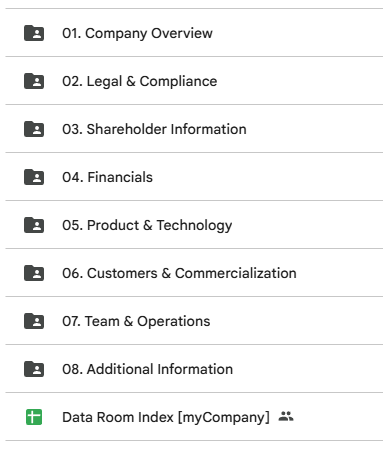
An early-stage structure might look like this →
anchor documents
Most investors don't review every file immediately. They often begin with a small number of documents that hold key information:
Investor Pitch Deck
Financial Snapshot or Model
Company Overview or Investment Memo
Data Room Index/Table of Contents
These documents help orient investors before they dive deeper.
Consisten, descriptive names
Avoid names like: Deck_v3_FINAL_FINAL.pptx
Instead, choose names tell investors exactly what they’re opening:
2026 Investor Pitch Deck
Customer Pipeline Overview
Financial Model Summary
Good file names reduce confusion and help investors find information quickly.
TranspaRency
At an early stage, it's normal for documents to be incomplete, evolving, or not yet applicable.
Rather than hiding gaps, provide context:
Include a brief note explaining what exists, what is still being developed, and what isn't applicable
Include a “Status” column in your Index, and add notes for content that isn’t yet there
Create placeholder folders and documents to indicate that you know which pieces are missing and are working on them
When sharing your data room, always ensure that you are following security protocols to protect your business and your competitive advantage.
Check out our Data Room Security FAQs for more on this topic →

Sample Data Room Structure
At the pre-seed/seed stage, data rooms often live within a Google Drive, Dropbox, or DocSend folder. You don’t need anything fancy.
Use this sample folder structure as a starting point, then adapt it to your company, industry, and stage of growth. You don't need every folder or document on day one—your data room should evolve alongside your business.
Not sure what documents to include?
Check out our Sample Early-stage Data Room Structure →
Where to next?
Browse Volition’s practical tools, guides, and research on pitching, capital raising, and the funding ecosystem.
Learn About our Founder Advising →
We support founders with practical, stage-appropriate guidance on investor readiness, pitching, and fundraising conversations.